Phone:
(701)814-6992
Physical address:
6296 Donnelly Plaza
Ratkeville, Bahamas.

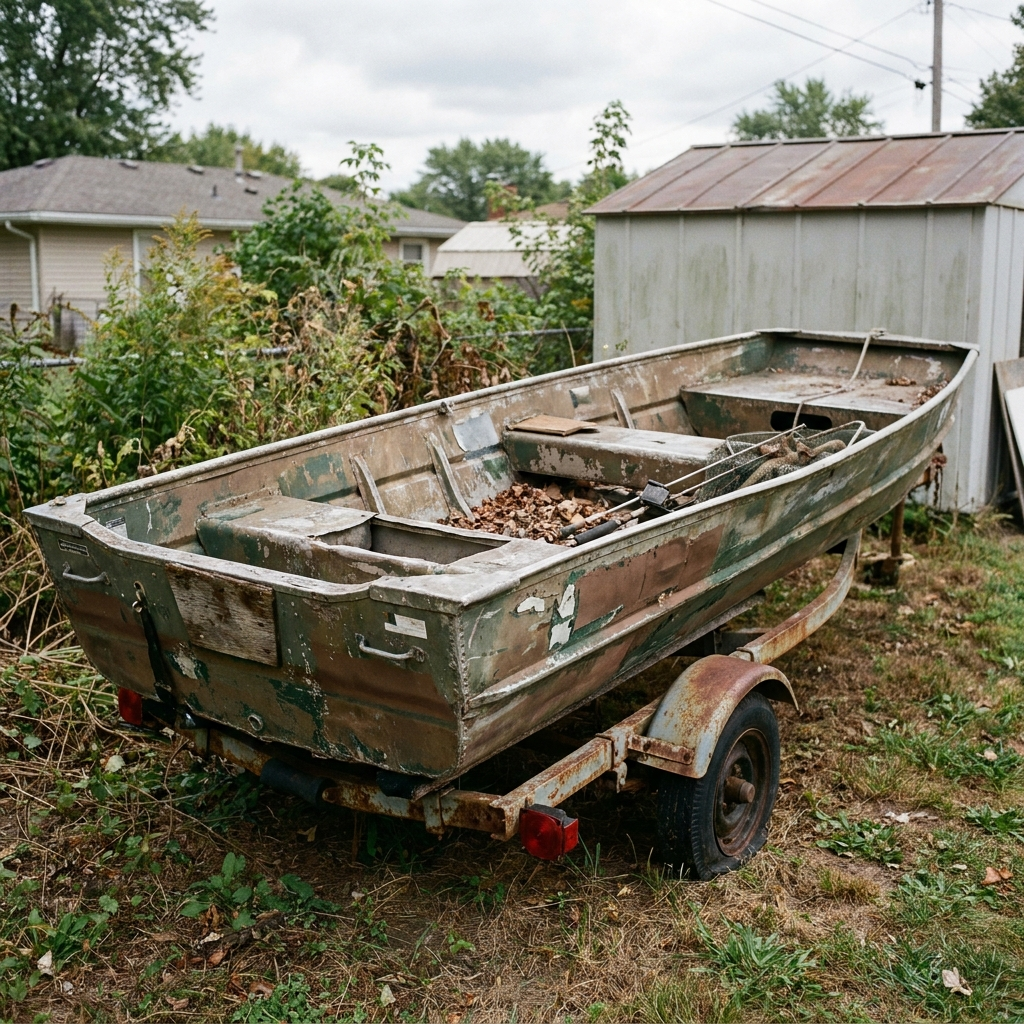
Drive around long enough and you’ll see them.
Old aluminum boats sitting behind garages, leaning against sheds, parked under trees or listed on Marketplace looking like they haven’t touched water in years.
Some are $500 fishing boats waiting for another chance.
Others are $500 introductions to a $5,000 problem.
So, is an old aluminum boat worth restoring?
Absolutely—if you start with the right boat.
A quality aluminum hull can have an incredibly long useful life. Faded paint, rotten flooring, ugly seats and outdated equipment can all be replaced. Even leaking rivets and a deteriorated transom don’t necessarily mean a boat is finished.
But restoration only makes sense when the boat underneath all those problems is worth saving.
At Tin Can Boat Works, that’s the first question we’d ask before starting any project:
Does this boat have good enough bones to justify what we’re about to put into it?
When evaluating an old aluminum boat, ignore the shiny stuff.
A trolling motor, fish finder, pedestal seats and newer outboard can add value, but none of them make a bad hull good.
The hull is the foundation of the entire project.
We’re much more interested in finding an older boat with a fundamentally sound hull than a heavily accessorized boat hiding structural problems underneath a nice-looking deck.
Look for:
Scratches and dents don’t automatically bother us.
It’s an aluminum fishing boat. If it’s been used for 20 or 30 years, we’d expect it to have some scars.
The important distinction is between cosmetic damage and structural damage.
Paint is easy.
Bad bones aren’t.
A few leaking rivets don’t necessarily make an older jon boat a bad restoration candidate.
Riveted aluminum boats can develop leaks as they age and after years of flexing, trailering and use.
What matters is the extent of the problem.
One or two problem areas are very different from a boat with leaks running throughout multiple seams.
Look for signs of previous repairs.
If someone has covered half the bottom of the boat with sealant, patches and mystery products from the hardware store, you need to figure out what they were trying to fix.
Sometimes the previous repair is worse than the original problem.
A boat doesn’t have to be perfect to be restorable.
But you should understand the problem before deciding what the boat is worth.
Rotten transom wood is common in older aluminum boats.
That alone wouldn’t necessarily scare us away.
If the surrounding aluminum structure is sound, rebuilding the transom may simply become part of the restoration.
What concerns us more is what prolonged transom problems may have done to the boat itself.
Inspect:
A rotten piece of wood can be replaced.
A badly damaged aluminum structure surrounding it can turn the job into something much more involved.
Aluminum doesn’t rust like steel, but corrosion can absolutely destroy an aluminum boat.
Surface oxidation isn’t necessarily alarming.
Deep pitting is.
Pay particular attention around:
Battery compartments deserve special attention.
Old batteries, leaking electrolyte, moisture and years of questionable wiring can create ugly surprises.
If the aluminum has lost significant material, you’re no longer talking about cleaning and refinishing.
You’re talking about structural repair.
This sounds backward, but we’d often rather look at an ugly original boat than one someone has already “restored.”
Why?
Because we can see what we’re buying.
Old paint doesn’t bother us.
Faded aluminum doesn’t bother us.
Sun-baked seats don’t bother us.
Even rotten plywood doesn’t necessarily bother us.
What makes us nervous is a boat covered in brand-new carpet, fresh paint and homemade decking when we can’t see what’s underneath it.
A fresh coat of paint can make almost anything look good in a Marketplace photo.
That doesn’t tell you what’s underneath.
For a restoration project, visibility has value.
Not every modification is an upgrade.
A properly installed floor, electrical system or storage compartment may save you work.
A poorly designed modification can create more work than starting with an untouched hull.
Look closely at:
Ask how everything was attached.
Look for unnecessary holes drilled into the hull.
Look for dissimilar metals.
Look for untreated wood against aluminum.
Look at the weight of what was added.
And don’t assume a tall casting deck is automatically desirable.
On a small or narrow jon boat, raising the angler higher above the bottom can change how stable the boat feels.
The best modification is one that works with the hull, not one that tries to turn every jon boat into a miniature tournament bass boat.
It’s easy to stand beside an empty hull and imagine everything you’re going to add.
Front deck.
Rear deck.
Two batteries.
Trolling motor.
Outboard.
Livewell.
Cooler.
Electronics.
Storage.
Three pedestal seats.
Then three anglers climb aboard.
All of that has weight.
If the boat still has its capacity plate, photograph it and use that information when planning the restoration.
The boat’s capacity and horsepower limitations don’t disappear because you’re rebuilding it.
A successful restoration isn’t about fitting as much equipment as possible into a small boat.
It’s about building a useful fishing boat within the limitations of the hull you started with.
Older boats sometimes contain flotation foam that has spent years exposed to water.
Depending on the material, condition and installation, saturated foam can add unwanted weight.
If you’re removing flooring during the restoration, inspect accessible flotation carefully.
Don’t automatically remove flotation simply because it’s old.
Flotation serves an important safety purpose, and altering it without understanding the original design can create problems.
The goal should be to understand what’s there, what condition it’s in and what needs to be addressed as part of a responsible rebuild.
A boat sitting on a trailer looks like one purchase.
Financially, you should evaluate them separately.
An old trailer may need:
Suddenly the “free trailer” included with the boat isn’t free at all.
On the other hand, a properly sized trailer in good condition can add considerable value to a project.
Make sure the trailer actually supports the boat correctly.
Poorly positioned bunks or rollers can damage an aluminum hull over time.
An old aluminum boat with an outboard may look like a much better deal than a bare hull.
Maybe.
The engine can also become the most expensive part of the project.
A motor that hasn’t run in years shouldn’t automatically be valued like a working motor.
Whenever possible, see it start cold and run.
Consider:
If you’re not comfortable evaluating an outboard, have someone who is inspect it or value the boat as though the motor may need substantial work.
“Probably just needs the carb cleaned” has launched plenty of expensive projects.
You can repair a transom.
You can replace flooring.
You can rewire a boat.
Fixing an ownership or title problem may be considerably less enjoyable.
Before buying an old aluminum boat, verify what paperwork is required in your state and make sure the seller has what you need to legally transfer ownership.
Check the Hull Identification Number and compare it with the paperwork.
Do the same for the trailer where applicable.
We’d rather pay more for a boat with clean paperwork than save a few hundred dollars buying somebody else’s title problem.
This is where restoration decisions become real.
Don’t ask:
Can I buy this boat for $800?
Ask:
What will I have invested when this boat is finished?
Your real project cost might look more like:
Boat purchase
Those “little” expenses add up remarkably fast.
A $500 boat isn’t automatically cheaper than a $1,500 boat.
Sometimes spending another $1,000 on a better starting point saves considerably more than $1,000 during the restoration.
This changes the math.
If you’re restoring a boat for yourself, financial return isn’t the only consideration.
Maybe it belonged to your father.
Maybe it’s the boat you learned to fish from.
Maybe you simply enjoy the project.
If you put $6,000 into a boat that would sell for $4,500 but you end up with exactly the fishing boat you wanted, that doesn’t necessarily mean the restoration was a mistake.
You got value from the project and from the finished boat.
If you’re restoring the boat specifically to resell it, the calculation is different.
Purchase price and restoration costs have to leave enough room for the finished boat to make financial sense.
That’s why the best restoration project isn’t necessarily the cheapest boat you can find.
It’s the boat with the best combination of:
Purchase price + condition + potential + finished value.
We’d consider an old aluminum boat a strong restoration candidate when it has most of the following:
It doesn’t need to be pretty.
It doesn’t even need to float perfectly when you buy it.
It needs to have good bones and a realistic path forward.
Sometimes the best restoration decision is leaving the boat exactly where you found it.
We’d become very cautious when we find:
One problem doesn’t necessarily kill a project.
It’s the combination of problems that usually does.
A boat with a bad transom might still be a good project.
A boat with a bad transom, severely corroded hull, questionable paperwork, junk trailer and seized outboard probably isn’t.
This may be the hardest part.
You see an old 14-foot aluminum boat and immediately picture what it could become.
New floor.
Casting deck.
Trolling motor.
Electronics.
Fresh paint.
Perfect little fishing rig.
Once you’ve mentally built the finished boat, it’s easy to start overlooking problems with the boat sitting in front of you.
Try to evaluate the project before imagining the finished product.
There will always be another old aluminum boat.
Walking away from the wrong one leaves your money available when the right one shows up.
Yes.
In fact, the right older aluminum boat can be an excellent foundation for a capable fishing rig.
Aluminum boats are simple, durable and adaptable. A good hull doesn’t stop being useful because the paint faded, the plywood rotted or the seats went bad.
But restoration isn’t about saving every old boat.
It’s about recognizing the ones worth saving.
At Tin Can Boat Works, we look past the cosmetics and ask whether the hull underneath has another chapter left in it.
When the answer is yes, that’s where the fun starts.
Small Boats. Serious Fishing.