Phone:
(701)814-6992
Physical address:
6296 Donnelly Plaza
Ratkeville, Bahamas.

Fishing boats get dirty.
Mud gets tracked across the deck. Fish leave slime and scales behind. Bait gets spilled. Drinks get knocked over. Leaves collect in corners. And somehow there’s always at least one soft plastic lure slowly melting into something it shouldn’t be touching.
That’s part of using a fishing boat.
The goal of cleaning an aluminum fishing boat isn’t to keep it looking like a showroom display.
It’s to remove dirt, salt, fish residue, moisture and other contaminants before they contribute to staining, corrosion, mildew, odors or deterioration.
The Tin Can Boat Works Aluminum Boat Cleaning & Care Guide covers practical cleaning for aluminum jon boats and V-hulls without turning boat ownership into a weekly detailing project.
Clean what needs cleaning. Protect what needs protecting. Let the boat dry. Then go fishing again.
For routine freshwater use, cleaning can often remain simple. 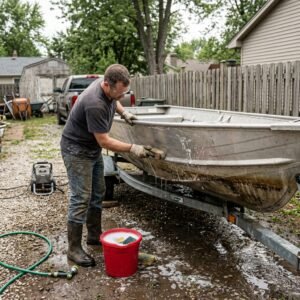
After a fishing trip:
After saltwater use, the cleanup deserves additional attention.
Thoroughly rinse appropriate exposed surfaces and equipment with freshwater, including the boat, trailer, outboard and trolling motor according to their manufacturers’ recommendations.
You don’t necessarily need to deep-clean the entire boat after every trip.
You do need to prevent contaminants and moisture from becoming permanent residents.
Aluminum is durable, but that doesn’t mean every cleaner or cleaning method is appropriate for it.
For normal dirt and grime, start with the least aggressive cleaning method that gets the job done.
That usually means:
Avoid immediately reaching for the strongest chemical in the garage.
More aggressive isn’t automatically more effective.
Loose dirt, sand, mud and vegetation should generally be rinsed away before scrubbing.
This reduces the amount of abrasive material being dragged across the surface.
Pay attention to areas where material collects:
Cleaning also gives you an opportunity to inspect the hull.
Look for:
A clean enough hull is an inspectable hull.
For normal washing, use cleaning tools that won’t unnecessarily scratch or damage the surface.
A soft brush or sponge is generally a better starting point than aggressive abrasives.
Remember that aluminum surfaces can vary considerably.
Your boat may have:
Treat the surface you actually have.
Don’t allow cleaner residue to sit indefinitely on aluminum surfaces.
Follow the product manufacturer’s directions for:
If you’re trying a product for the first time, test it in an inconspicuous location when appropriate.
Future Resource: Cleaning & Protecting Bare Aluminum Boat Hulls →
Painted aluminum needs to be treated as a coated surface.
The goal is to clean the boat without unnecessarily damaging the coating protecting the metal underneath.
Use products compatible with the particular finish.
Avoid aggressive scrubbing that can:
Washing a painted hull is a good opportunity to look for:
A small scratch doesn’t necessarily require immediate major repair.
But coating damage shouldn’t automatically be ignored either.
If corrosion is developing underneath a painted surface, simply covering it with more paint may not address the underlying problem.
Determine what’s happening first.
A product designed for a car isn’t necessarily the best product for an aluminum fishing boat.
Consider the:
Use products appropriate for the finish you’re maintaining.
The inside of a fishing boat may contain several different materials, and each can require somewhat different care.
Carpet can hold:
Remove loose debris and clean the carpet using methods appropriate for marine carpeting.
One of the biggest concerns is allowing carpet and the material underneath it to dry properly.
Repeatedly covering wet carpet can contribute to:
Cleaning it is only half the job.
Letting it dry matters too.
EVA-style marine flooring has become popular because it’s comfortable, provides traction and can make a small fishing boat considerably nicer to use.
For routine care:
Follow the flooring manufacturer’s recommendations whenever available.
Be particularly careful with solvents and aggressive cleaners that could discolor, soften or damage foam materials or their adhesives.
Decks may use marine paint, non-skid coatings or other finishes.
Use cleaning methods compatible with the coating.
Aggressive scrubbing can gradually wear away non-skid surfaces and paint.
The goal is to remove dirt without removing the deck.
Future Resource: Cleaning Marine Carpet & EVA Foam Flooring →
Boat seats have a difficult job.
They’re exposed to:
Routine cleaning helps prevent grime from becoming embedded in the material.
Fish residue, food, drinks and other contaminants are usually easier to remove shortly after they happen.
Use cleaning products intended for marine vinyl or the particular seating material.
Follow the seat or cleaner manufacturer’s recommendations.
Mildew often indicates that moisture and poor ventilation are part of the problem.
Cleaning the visible mildew without correcting the damp environment may mean it simply returns.
After cleaning:
Aggressive chemicals can potentially damage:
Don’t use a stronger cleaner than necessary simply because a stain is stubborn.
Anything that holds fish, bait or water can become unpleasant quickly if it isn’t cleaned.
That includes:
Clean out:
Organic residue can create odors and staining when left inside a warm boat.
Make sure water can drain properly.
Inspect drains and screens for blockage.
If the livewell uses pumps and plumbing, periodically inspect:
A livewell that isn’t draining correctly can also create moisture problems elsewhere in the boat.
Don’t immediately close a wet livewell and leave the boat sitting in the sun for a week.
When practical, allow the compartment to dry and ventilate.
Your nose will appreciate the effort on the next fishing trip.
Future Resource: How to Clean & Maintain a Boat Livewell →
Saltwater fishing places additional demands on boats, trailers and equipment.
Aluminum fishing boats can be excellent saltwater boats when they’re properly equipped and cared for.
Post-trip cleanup becomes particularly important.
After saltwater use, rinse appropriate exposed components with freshwater as soon as practical.
Pay attention to:
Follow manufacturer recommendations for electronics, outboards, trolling motors and other equipment.
Saltwater can collect in areas that don’t receive much attention.
Inspect:
The obvious flat surfaces are usually the easiest areas to rinse.
It’s the corners and hardware that deserve a second look.
Follow the engine manufacturer’s flushing procedure for your particular outboard.
Don’t assume every outboard uses the same flushing method.
The manufacturer’s procedure takes priority over generic advice.
The trailer may receive more saltwater exposure than almost anything else in the rig.
Freshwater rinsing should include appropriate areas such as:
Saltwater trailer care is part of boat care.
Future Resource: Aluminum Boat Care After Saltwater Fishing →
There isn’t one universal list of chemicals that applies to every aluminum boat because boats can contain many different surfaces and coatings.
The better rule is:
Don’t use a chemical unless you know it’s compatible with the material you’re cleaning.
Be particularly cautious with:
Mixing household or industrial cleaning chemicals can create dangerous reactions or gases.
Use products according to their labels and never create your own chemical mixture unless the product manufacturer specifically directs it.
If the instructions call for dilution, follow them.
Using twice as much chemical doesn’t necessarily clean twice as well.
It may simply increase the chance of damaging the surface.
When appropriate, test a new cleaning product in a small inconspicuous area before applying it broadly.
That’s considerably better than discovering halfway through the boat that the cleaner changes the finish.
Future Resource: Aluminum-Safe Boat Cleaning Products & Methods →
Cleaning a boat and immediately sealing all the moisture inside it defeats part of the purpose.
After washing:
Whenever practical, store the boat in a position that allows water to move toward appropriate drains rather than collecting inside.
Keep drainage paths clear.
If the drain plug is normally removed during storage, develop a consistent system for storing it with the boat so it’s available for the next trip.
A cover can protect a boat from:
But a poorly ventilated cover can also trap moisture.
Make sure the cover is properly supported so water doesn’t pool and provide appropriate ventilation for the boat and storage conditions.
Keeping rain out while creating a damp greenhouse underneath isn’t the goal.
Future Resource: How to Store an Aluminum Fishing Boat →
↑ Back to Cleaning Menu
There’s no universal cleaning schedule.
It depends on how and where the boat is used.
A freshwater boat that spends a quiet morning on a clean lake may need very little cleaning afterward.
A boat that comes home covered in:
needs more attention.
Instead of cleaning according to the calendar, clean according to the conditions.
Remove anything likely to:
Perform a more thorough cleaning that gives you an opportunity to inspect:
Cleaning and inspection work well together.
A fishing boat doesn’t have to be spotless to be well maintained.
A scratch from a dock doesn’t mean the boat is neglected.
Mud on the deck after a fishing trip means the boat probably got used.
That’s a good thing.
The problems begin when salt, water, fish residue and grime are allowed to sit long enough to damage the materials underneath them.
Clean what needs cleaning.
Rinse what needs rinsing.
Let wet areas dry.
Use products appropriate for the surfaces.
And while you’re cleaning, take a minute to actually look at the boat.
You may catch a loose fastener, developing corrosion or damaged component before it becomes something more serious.
The goal isn’t a boat that’s too clean to fish.
It’s a boat that’s maintained well enough to keep fishing.
Tin Can Boat Works
Small Boats. Serious Fishing.