Phone:
(701)814-6992
Physical address:
6296 Donnelly Plaza
Ratkeville, Bahamas.
Compare 12′, 14′ and 16′ jon boats for fishing. Learn how size, width, stability, capacity, horsepower and fishing style affect which jon boat is best.
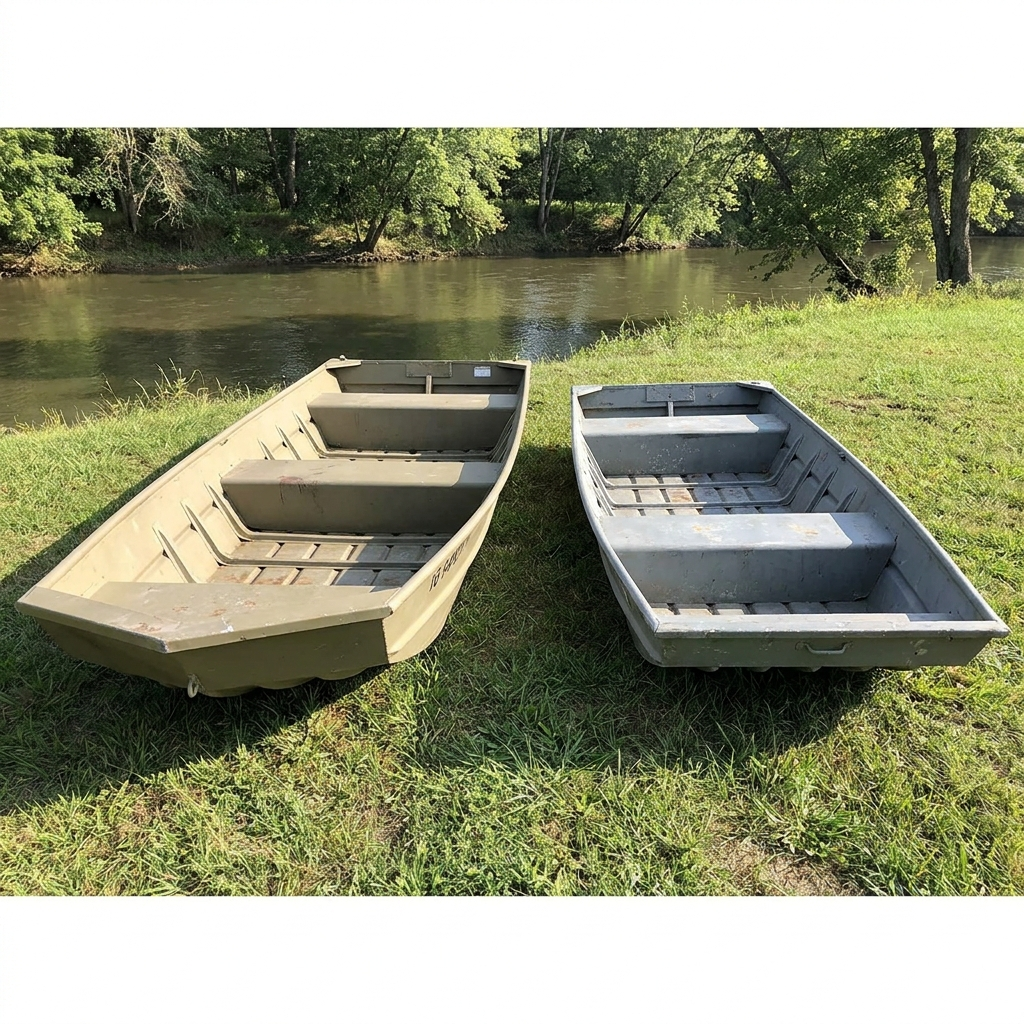
Jon boats are available in a huge range of sizes, but 12-, 14- and 16-foot boats are among the most common choices for anglers looking for a simple, affordable aluminum fishing boat.
So which size is best?
The easy answer would be 16 feet. More boat means more room, more capacity and usually more stability.
But that’s not always the right answer.
A wide 14-foot jon boat can make a better fishing platform than a narrow 16-footer. A lightweight 12-foot boat may be exactly what an angler needs for small lakes and hard-to-reach water. And a 16-footer loaded with decks, batteries and equipment may defeat the simplicity that made someone want a jon boat in the first place.
The best jon boat size for fishing depends on where you fish, how many people you carry, what equipment you need and what you expect the boat to do.
Here’s how we look at the three most common sizes.
Before comparing 12-, 14- and 16-foot jon boats, there’s an important point to understand:
Don’t shop for a jon boat based on length alone.
Two 14-foot jon boats can be dramatically different fishing platforms.
One might be a narrow, lightweight utility boat designed for protected water. Another might have a wide bottom, greater beam, higher sides and considerably more capacity.
When comparing jon boats, look at:
For fishing purposes, width deserves particular attention.
A wider bottom generally provides a more stable platform for anglers moving around, casting and standing.
That’s especially important if you’re planning to add a casting deck.
A 12-foot jon boat represents small-boat fishing in its simplest form.
They’re lightweight, inexpensive and easy to move. Depending on the boat, one person may be able to launch one in places where putting a larger boat in the water would be difficult.
A 12-footer can be an excellent choice for:
They’re also relatively easy to tow.
You don’t necessarily need a large tow vehicle, and some 12-foot boats can be transported or launched without a conventional boat ramp depending on the hull and setup.
Space disappears quickly in a 12-foot boat.
Add a battery, trolling motor, fuel tank, cooler, tackle, rods and two anglers, and what looked roomy sitting empty in someone’s yard can become crowded very quickly.
The smaller hull can also be more sensitive to movement.
An angler standing, turning or stepping to one side may affect the boat noticeably more than in a wider, larger hull.
That’s why we’d be particularly cautious about installing a tall casting deck in a small, narrow jon boat.
Raising the angler raises weight within the boat and can change how stable the boat feels.
Sometimes the best fishing setup for a 12-footer is also the simplest:
Low floor. Good seat. Trolling motor. Battery. Tackle. Go fishing.
Not every jon boat needs to become a miniature bass boat.
For many anglers, the 14-foot jon boat is the sweet spot.
It’s still relatively small and easy to tow, store and launch, but those additional two feet can make a significant difference in usable fishing space.
More importantly, 14-foot jon boats are available in a wide variety of widths and configurations.
A properly sized 14-footer can offer enough room for:
without turning into a large or complicated boat.
That’s an attractive combination.
A wide 14-foot aluminum hull can make an excellent foundation for a purpose-built fishing conversion.
This is where we’d start paying very close attention to the numbers following the boat’s length.
You’ll often see jon boats described with numbers such as:
1436
1440
1448
The first two numbers generally indicate approximate length, while the second two typically refer to bottom width.
So a 1436 and 1448 may both be approximately 14 feet long, but they are very different boats.
That extra bottom width can affect:
If your goal is to stand and cast, carry another angler and build in some storage, we’d generally be much more interested in a wider 14-foot hull than simply finding the cheapest 14-footer available.
Move up to a 16-foot jon boat and you begin getting into a substantially more capable fishing platform.
The additional length can provide more room for anglers, equipment and storage while making it easier to distribute weight throughout the boat.
A wide 16-footer can become a serious fishing machine.
Depending on the hull, a 16-foot boat may provide:
For anglers carrying substantial gear or regularly fishing with another person, the extra space can be valuable.
It’s also easier to design different fishing zones within the boat.
You may have a forward casting area, central seating/storage and rear fishing position without everyone constantly stepping over equipment.
More boat also means more boat to deal with.
A 16-footer may require:
And then there’s the temptation to fill all that additional space.
More deck.
More storage.
More batteries.
More electronics.
More accessories.
Before long, the simple aluminum fishing boat you wanted has become heavy, expensive and complicated.
Bigger only helps if you actually need the additional capability.
Best for: One angler, small water and simple setups.
Advantages:
Considerations:
Best for: One or two anglers wanting a versatile small fishing boat.
Advantages:
Considerations:
Best for: Anglers wanting more room, capacity and fishing capability.
Advantages:
Considerations:
For a solo angler, a 12- or 14-foot jon boat can make an excellent fishing platform.
The decision comes down to how much equipment you carry and where you fish.
If your idea of fishing is a trolling motor, battery, a couple rods and a tackle box on a protected lake, a 12-footer may be all the boat you need.
If you’re adding an outboard, electronics, multiple batteries, storage and a more developed fishing layout, a wider 14-footer provides considerably more flexibility.
For many solo anglers, we’d lean toward the 14-footer simply because it provides room to grow without becoming difficult to handle.
For two adults fishing regularly, we’d generally start looking seriously at wide 14-foot and 16-foot hulls.
That doesn’t mean two people can’t fish from a 12-footer.
They certainly can.
But there’s a difference between fitting two people in a boat and giving two anglers enough room to fish comfortably.
Think about two people casting.
Now add:
Space gets consumed surprisingly quickly.
If regularly carrying three adults is part of the plan, we’d strongly favor looking at larger and wider hulls rather than trying to force the job onto a smaller boat.
The boat’s capacity plate—not guesswork—needs to be part of that decision.
Remember that capacity includes more than just people.
People, motors, fuel, batteries and equipment all contribute to the load the boat is carrying.
This question should actually be:
What hull is best for a casting deck?
Length alone doesn’t answer it.
A narrow jon boat with a high casting deck may feel considerably less stable than the same boat with the angler standing closer to the bottom of the hull.
For a fishing conversion with elevated casting areas, we’d look closely at:
A low fishing platform on a wider hull may be a much better design than building a tall deck simply because that’s what bass boats have.
The boat should dictate the build.
The build shouldn’t fight the boat.
The best jon boat for a small protected lake may not be the best jon boat for larger open water.
Flat-bottom jon boats excel in shallow, protected environments, but their ride characteristics can become less comfortable as waves and chop increase.
If you regularly fish larger lakes where conditions can change, a modified-V or small aluminum V-hull may deserve consideration instead.
That’s another reason we don’t believe there’s one “best” small fishing boat.
The right hull depends on the job.
There’s an unexciting question that can save you a lot of aggravation:
Where are you going to put the boat?
Measure before you buy.
Consider:
The difference between storing a 12-foot and 16-foot boat isn’t just four feet.
Once the trailer, tongue and outboard are included, the complete package can take up considerably more room than the advertised boat length suggests.
If someone asked us to pick one size without knowing anything else about how they fish, we’d probably start by looking at a wide 14-foot jon boat.
Not because 14 feet is magically the perfect size.
It’s because a good 14-foot hull can provide an excellent compromise between:
Fishing space + stability + capacity + portability + affordability.
For many anglers, that’s enough boat to build a very capable fishing rig without losing the simplicity that makes small aluminum boats so appealing.
But we’d take a good wide 16-footer over an undersized 14-footer when the fishing situation requires it.
And we’d happily fish a simple 12-footer when that’s all the water requires.
It’s easy to shop for the boat you imagine yourself needing someday.
A better approach is to think about how you actually fish.
Ask yourself:
Then start looking for the hull that fits those answers.
At Tin Can Boat Works, that’s how we approach small-boat builds.
We don’t believe every jon boat needs a giant casting deck, a pile of electronics and every accessory in the catalog.
Sometimes the best fishing boat is the simplest one.
And sometimes an old aluminum hull that’s the right size, width and design is exactly what you need to build it.
Small Boats. Serious Fishing.